Key takeaways
- Reception depends on where the broadcast towers are, the terrain and buildings in between, and how high and how well aimed your antenna is — not on the antenna's advertised range.
- Most of the big Dallas–Fort Worth stations transmit from one place: the tower farm in Cedar Hill, south-southwest of Dallas. That makes a well-aimed directional antenna a strong option for many homes in the metroplex.
- An amplifier makes up for signal lost in long cables and splitters. Too much gain overloads the TV tuner and can make reception worse, not better.
- Rescan the TV after every change to the antenna, and periodically anyway — stations move frequencies.
Free over-the-air TV is one of the better deals left in home entertainment: the local networks, public television and dozens of subchannels, in high definition, with no monthly bill. But it only works if the antenna actually pulls the channels in. Plenty of people put up an antenna, run a scan, and find half the stations they expected simply aren't there.
That's exactly where one of our customers in Allen started. His attic antenna "was not picking up some channels I wanted." After the work was done, in his words: "My reception went from 15 to over 90 channels." This guide explains why reception varies so much across Dallas–Fort Worth, what actually fixes it, and what we did in his attic.
Why two houses a mile apart can get different channels
Digital TV doesn't fade gracefully. An old analog picture got snowy as the signal weakened; a digital tuner either locks onto a station or it doesn't. As AntennaWeb puts it, a station's signal "must be above a pre-determined minimum threshold, or the tuner will disregard that station altogether." So a small difference in signal can be the difference between a perfect picture and no channel at all.
What decides whether you clear that threshold? AntennaWeb, which publishes the Consumer Technology Association's antenna classifications, lists the factors. They include your location relative to each transmitter, the distance and direction to it, the station's power, the RF channel it broadcasts on, the terrain in between, the size and type of your antenna, its height above the ground, and the direction it's pointed.
The FCC adds the local details: "nearby buildings, trees, terrain or home construction." That's why a neighbor's result tells you very little about yours. Different roofing, a stand of trees to the south, or a slight rise in the ground between you and the towers all change what reaches the antenna.
Where the DFW signals come from
Here's the useful part for anyone in the metroplex. Most of the big Dallas–Fort Worth stations don't transmit from Dallas or Fort Worth themselves. They broadcast from the tower farm in Cedar Hill, south-southwest of Dallas. The City of Cedar Hill describes itself as having "the highest concentration of radio and television communication antennas in the country," with towers reaching thousands of feet into the air, on ground it notes is the highest elevation between the Red River and the Gulf of Mexico.
That concentration matters for antenna choice. When most of the stations you want sit in roughly one direction from your house, you can use an antenna that looks hard in that direction instead of one that listens weakly everywhere. For a home in Allen, north of Dallas, that direction points back across the whole metroplex toward Cedar Hill — a long way for a signal to travel over rooftops and terrain.
Not every station shares a site, though, and some smaller stations transmit from elsewhere. That's why the first step is always to check your own address.
Check your address before you buy anything
The FCC's DTV Reception Maps list every station predicted to reach a location, with its signal strength and the direction to its transmitter. Two cautions from the FCC itself are worth knowing. The strength calculations "assume an outdoor antenna 30 feet above ground level," and "actual reception quality may vary significantly for viewers using an indoor antenna." Attic antennas sit in between — higher than a set-top antenna, but behind roofing and framing.
Use the map as a guide to direction and difficulty, not a promise. If the stations you care about show as weak, plan for a bigger antenna, more height, or both.
Directional or multi-directional?
Antennas fall into two broad classes. The CTA's color-coded labeling standard, explained on AntennaWeb, separates them:
- Multi-directional antennas (the yellow and green codes) "receive signals equally well from all directions." The trade-off is range: they are "susceptible to noise from weak, distant signals."
- Directional antennas (the red, blue and violet codes) "have a much greater effective range in the direction they are aimed; however, they may be incapable of receiving relatively close stations from other directions around the compass."
Put simply: if your stations come from several directions and they're all strong, a multi-directional antenna is convenient. If the channels you're missing are distant and mostly in one direction — which describes a lot of the metroplex relative to Cedar Hill — a directional antenna, carefully aimed, is usually the better tool.
Why attic placement changes everything
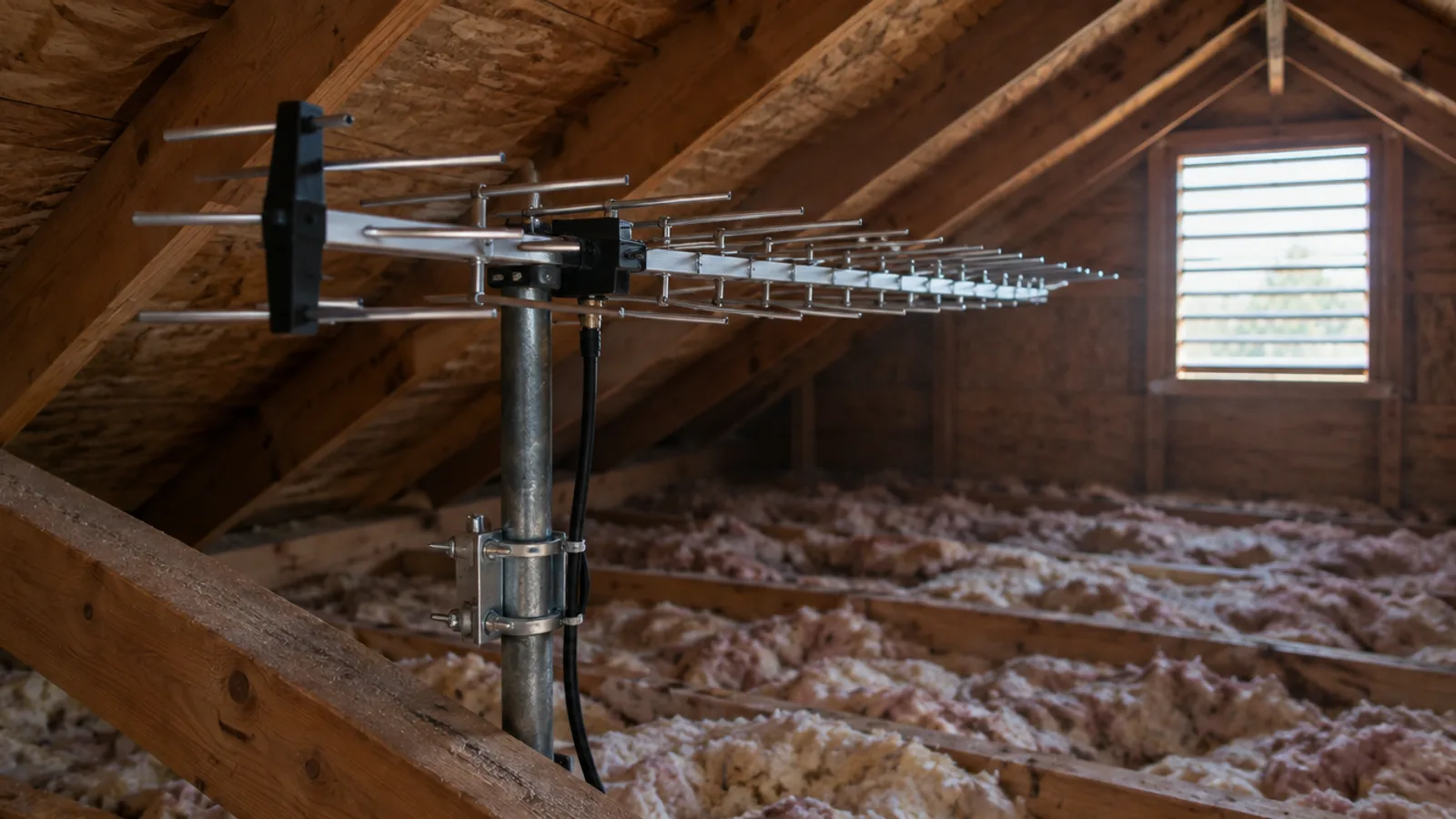
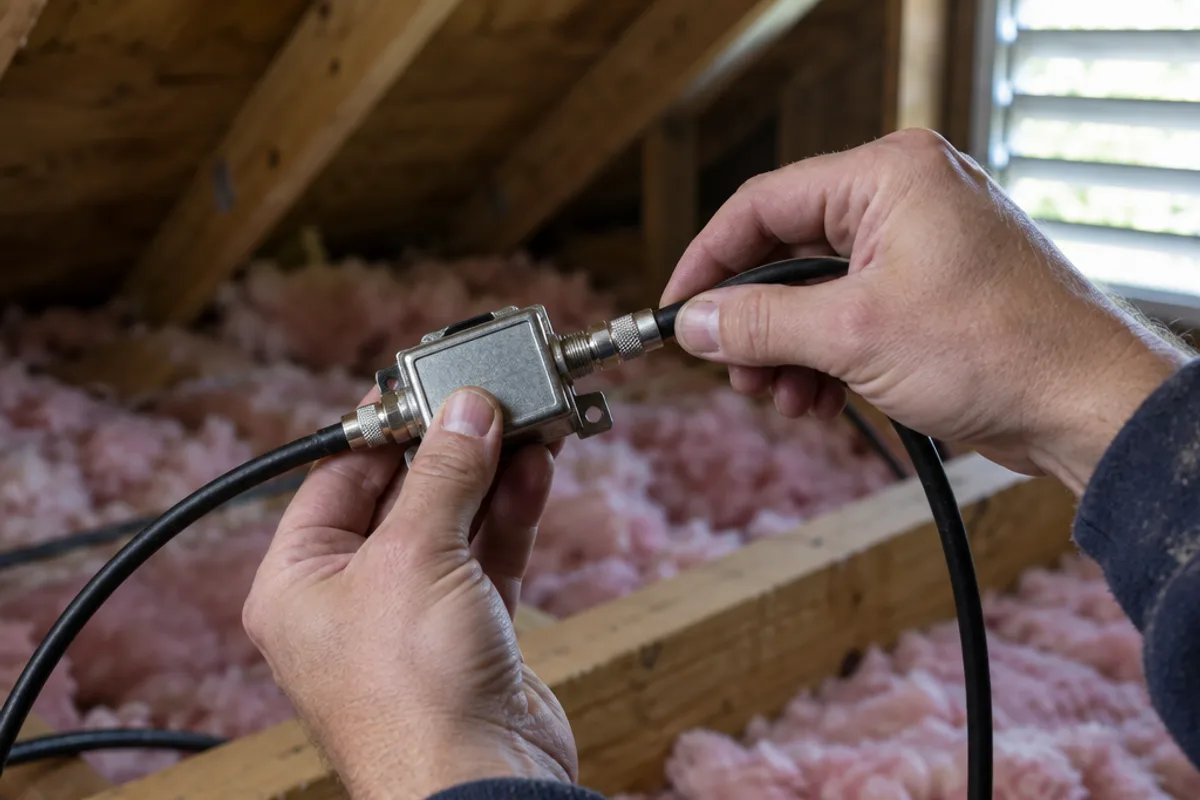
An attic is a popular compromise. The antenna is out of sight, protected from the weather, and higher than anything inside the house. But the attic isn't a clean environment for radio signals. AntennaWeb notes that indoor installations are affected by "the structure's sheathing, roofing, siding and other building materials, the presence of gas, water, and electrical lines, HVAC systems," and more.
The FCC's advice is simple and matches what we see on jobs: "DTV reception can often be improved just by changing the location of your current antenna, even as little as a few inches." Moving it away from ductwork, a vent stack or a metal-faced beam can bring a station back. The FCC also recommends moving slowly, so the TV has time to show the change, and using the TV's signal-strength meter if it has one.
This is the part Robert G. described so well. Aji replaced his antenna "with a directional antenna and moved its location in the attic several times to maximize the reception." As he put it: "This sounds simple but it is not. Positioning the antenna seems to be as much an art as a science based on where the broadcast stations are located, your neighborhood, the terrain, distance from the source, etc."
What an amplifier does — and why more isn't better
Every foot of coax cable and every splitter loses some signal. Channel Master, which makes antennas and amplifiers, explains that "the signal level drops at each splitter output" and that attenuation grows with longer cable runs. An amplifier makes up for those losses.
But amplifiers have two catches. First, they "don't discriminate": everything coming in is boosted, including unwanted signals, and the amplifier adds some noise of its own. Second, "too much gain from an amplifier can boost already strong signals to the point where they overload the TV receiver, creating distortions and unwanted interference." The FCC says the same from the other side: if you're near a transmitter, strong-signal "overload" can impede reception, and removing the amplifier or adding an attenuator can help.
Channel Master's own guidance is to start with the antenna, add amplification only as needed, and on switchable models "use the lowest gain setting that provides reliable reception across all channels." That balance is what Robert described: "it was necessary to add an amplifier to boost the signals from different stations. This required achieving an optimum balance of the amplification factor to achieve the desired outcomes."
Rescan after every change
A TV only knows about the channels it found on its last scan. The FCC recommends a scan before you change anything, another after you adjust the antenna, and periodic rescans anyway, because stations sometimes move to a different frequency while keeping the same channel number. The FCC's rescan guide walks through it; on most TVs it lives under the setup or channel menu.
The Allen job, in the customer's words
Here is how Robert G. of Allen described the result: "Aji accomplished this goal. My reception went from 15 to over 90 channels. More importantly, this included the channels I wanted." He also noted that "It took two visits because of the need to order a part but he persevered."
His full review is on our Video, TV & antennas service page.
When to call someone
If a rescan and a few careful moves of the antenna don't bring your channels back, the answer is usually one of three things: the wrong type of antenna for where your stations are, a location in the attic that's fighting the building, or an amplifier doing more harm than good. Sorting that out means testing on site, with the channel list you actually care about.
That's what a free walkthrough is for. We'll look at your attic and cable runs, check what your address should receive, and tell you plainly what would change the result — and what wouldn't. Book a free walkthrough.
Sources
- Antennas and Digital Television — Federal Communications Commission
- DTV Reception Maps — Federal Communications Commission
- Remember to Rescan — Federal Communications Commission
- Antenna Info (CTA antenna color codes) — AntennaWeb, TitanTV
- TV Antenna Amplifiers & How They Work — Channel Master
- City factoids — City of Cedar Hill, Texas
- Site of the Week: Cedar Hill Tower Farm (South End), Dallas — Fybush Media